Stepping into a mid-management role for the first time is a career milestone. I had just been promoted to a mid-management position. For me, it was a mix of excitement and pressure. I had supervised frontline employees in a corporate environment, but now, I’d be overseeing frontline leaders and reporting directly to senior management. While I was eager to lead in this new role, I quickly learned that leadership isn’t just about stepping up—it’s about leveling up. Reflecting on those first 90 days, I can see the mistakes I made, and I want to share them so others can avoid the same pitfalls. Here are five common leadership mistakes mid-managers often make in their first three months. To frame these lessons, I’ll also draw from John Maxwell’s Five Levels of Leadership and my own experiences as a former US Marine Corps leader.
Mistake #1: Jumping to Solutions Instead of Asking Questions
As a newly promoted leader, I felt compelled to prove I belonged. I thought having the answers and providing quick fixes was what made me credible. For example, when a team struggled with a bottleneck in production, I immediately suggested increasing staff on the line. While my solution addressed the symptom, it ignored the root cause—a fundamental Lean principle (Which I would learn later in my corporate career).
In the Marine Corps, leaders are trained to assess the battlefield before making decisions. Rushing to act without understanding the situation often leads to failure. A platoon leader who skips reconnaissance to “save time” might put their Marines in harm’s way unnecessarily.
Lesson Learned: In Lean Thinking organizations, asking questions like, “Why is this happening?” and practicing techniques like the 5 Whys is far more effective than offering surface-level fixes. Leaders don’t need to have all the answers; they need to guide the team to uncover them. This aligns with Maxwell’s Level 3 leadership—producing results through empowering others.
Maxwell’s Level 3 leadership emphasizes the importance of producing results by empowering others. At this stage, leaders transition from simply building relationships to driving outcomes through their team’s collective efforts. For example, in Lean Thinking, this means fostering a culture where team members feel ownership of the problem-solving process. Instead of solving issues for the team, leaders guide them to identify root causes, test solutions, and implement sustainable improvements. “guide” is the key word in my last statement…I have learned that even when I think I know the answer, I still ask my team, “what do you think?” This simple question engages their thinking, empowers them to be part of the solutions, drives ownership, and develops problem solving capabilities. By enabling others to succeed, leaders not only achieve better results but also build a foundation of trust and accountability that aligns with continuous improvement principles.
Mistake #2: Overloading the Team with Too Many Changes
Eager to drive results, I introduced several new initiatives right away: updating metrics boards, revising standard work, and reorganizing daily huddles. I thought these changes would enhance efficiency, but instead, I overwhelmed the team. People were confused, and it led to resistance.
In the Marine Corps, we were taught to focus on “mission-critical objectives” when resources are limited. For instance, during a field exercise, a new squad leader who tried to implement multiple tactical adjustments at once often confused their team and disrupted cohesion. What worked instead was a deliberate focus on incremental changes. The squad leader began by addressing one critical issue—streamlining communication during patrols. By implementing a clear and simple communication protocol, the team saw immediate improvements, which built confidence and set the stage for tackling additional challenges one step at a time. This approach ensured the team could adapt and grow without feeling overwhelmed.
Lesson Learned: Change should be incremental and aligned with the team’s capacity to absorb it. In Lean environments, a focus on continuous improvement (kaizen) means small, sustainable changes that build momentum. Leaders should prioritize and implement one improvement at a time, progressing toward Maxwell’s Level 4 leadership—developing others by building their confidence and fostering their growth. Maxwell’s Level 4 leadership focuses on creating leaders within the team by mentoring, training, and providing opportunities for others to step into leadership roles. In a Lean context, this could mean coaching team members to lead kaizen events or take ownership of specific process improvements. By cultivating the leadership potential of others, a Level 4 leader builds a resilient team capable of sustaining continuous improvement even in the leader’s absence.
Mistake #3: Neglecting Relationships and Trust-Building
I was so focused on hitting KPIs and addressing operational gaps that I neglected to connect with my team on a personal level. One team member told me, “It feels like you care more about numbers than about us.” That comment stung, but it was true. Luckily, I learned very quickly this was not the way to find true success.
In the Marine Corps, leaders eat last—literally and figuratively. During field exercises, the officers and NCOs ensured their Marines were fed and rested before addressing their own needs. This built trust and loyalty within the unit. One moment that stands out for me was during SERE (Survival, Evasion, Resistance, and Escape) school, when our group was cold, hungry, and exhausted. Our Captain, who hadn’t eaten all day himself, chose to give his single bowl of soup to us instead. Other officers quickly followed in his footsteps. That selfless act demonstrated his deep care for our well-being and cemented our trust in him. It was a vivid example of servant leadership in action.
Lesson Learned: Lean Thinking emphasizes respect for people. Building trust and relationships is foundational to creating an engaged workforce. Simple actions like listening during Gemba walks or asking about team members’ challenges can make a significant difference. Maxwell’s Level 2—building relationships—is crucial for earning trust and buy-in. At this level, leaders move beyond positional authority and begin to connect with their team on a personal level. This means understanding individual motivations, valuing contributions, and creating an environment where people feel seen and heard. In Lean Thinking, this often takes shape during Gemba walks or informal check-ins, where leaders can build rapport by listening to concerns and celebrating small wins. By focusing on relationships, leaders create a foundation of trust that fosters collaboration and engagement.
Mistake #4: Micromanaging Instead of Empowering
In my eagerness to ensure the team’s success, I became overly involved in their day-to-day tasks. I attended every meeting, reviewed every detail, and often made decisions that the team could have handled. This undermined their autonomy and slowed progress. I once worked with a senior manager who epitomized this approach. He rarely left his office, instead issuing demands via email and requiring every decision to pass through his approval. This created delays and frustrated the team, who felt stifled and unable to act independently. His leadership style became a bottleneck rather than an enabler of progress.
In the Marine Corps, decentralized command is key. Junior leaders are entrusted with decision-making authority to adapt to changing circumstances. A micromanaging platoon commander stifles initiative and delays critical actions. This reminds me of the lessons from Michael Abrashoff’s book, It’s Your Ship. Mike Abrashoff transformed his ship’s culture by getting out of his office, actively engaging with the crew, and empowering them to make decisions within their areas of responsibility. Unlike the senior manager I worked with, Abrashoff demonstrated that trust and decentralized decision-making lead to greater ownership and higher performance. His approach contrasts sharply with leaders who rely on control and rigid oversight, highlighting the importance of empowerment in any organization. His leadership style became a bottleneck rather than an enabler of progress.
Lesson Learned: Lean leaders coach and develop their team’s problem-solving capabilities. By stepping back and empowering the team to own their work, leaders foster a culture of accountability and continuous improvement. Providing guidance without controlling the process is key to Maxwell’s Level 5 leadership—creating other leaders. At Level 5, leaders focus on building a legacy by developing people who can lead in their absence. This involves not just delegation but intentional mentorship and trust. In Lean Thinking, this might mean training team members to facilitate improvement events, take ownership of strategic projects, or mentor their peers. Leaders at this level measure success not just by results, but by the growth and leadership capability of their teams. By cultivating a culture of continuous development, a Level 5 leader ensures the organization thrives beyond their tenure.
Mistake #5: Focusing on Results Over Process
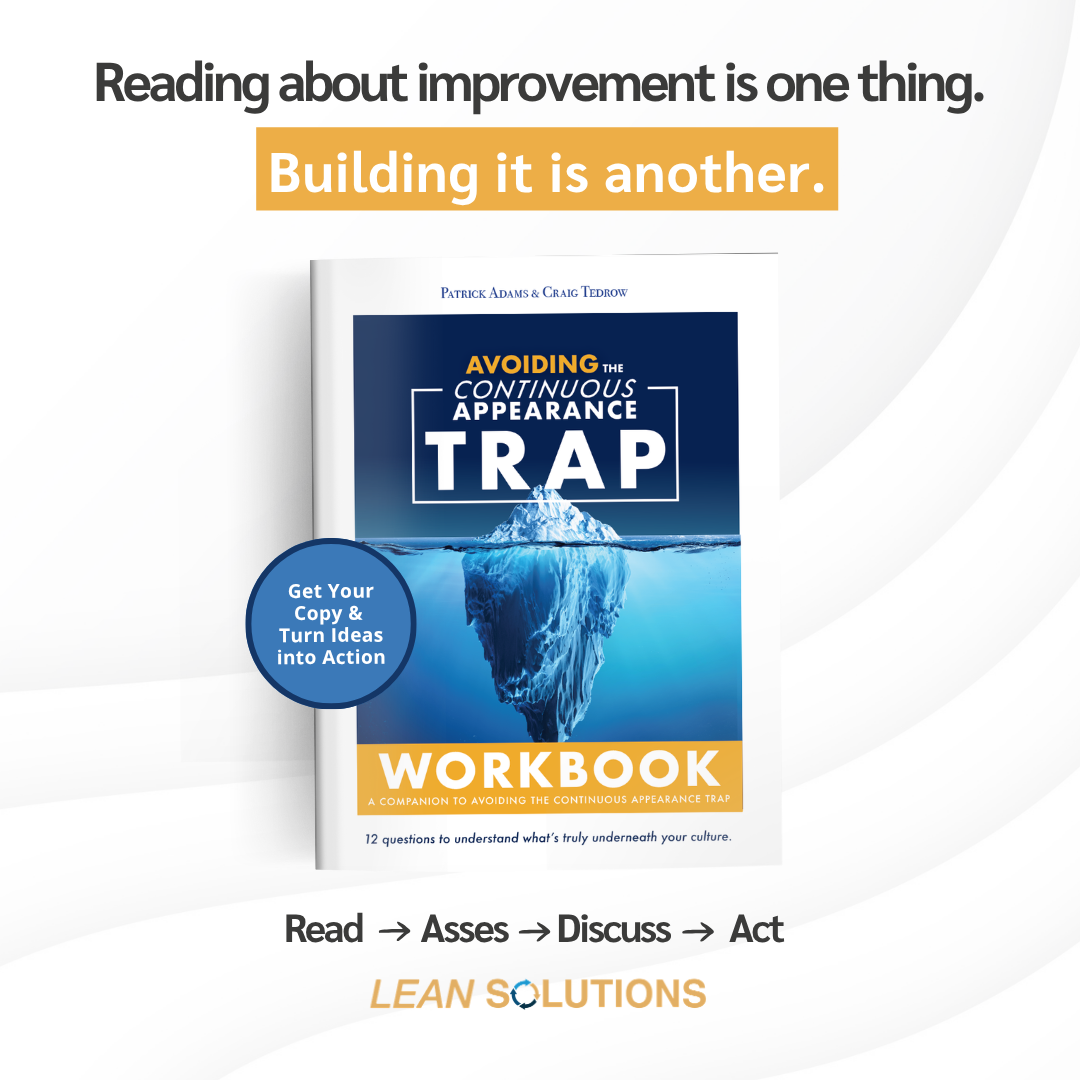
Early on, I was hyper-focused on achieving immediate results: improving lead times, reducing defects, and hitting production targets. What I missed was that in a Lean organization, results are a byproduct of excellent processes. My time at two distinct companies taught me a critical lesson about this. (You can read about these two companies in my Shingo Award Winning book, Avoiding the Continuous Appearance Trap) One company operated with what I call a ‘continuous improvement culture,’ where leaders set clear expectations, enabled action, and sustained results. The other had what I labeled a ‘continuous appearance culture,’ where leaders focused on short-term results and surface-level fixes to appear effective, but failed to address systemic issues. Based on my time spent in both organizations, I learned that leaders who set clear expectations create clarity for their teams. Once those expectations are in place, leaders must enable the right actions—actions rooted in process improvements, not firefighting. Finally, results must be sustained through ongoing accountability and support.
I often show this distinction with a simple diagram that highlights these three key elements: setting expectations, enabling action, and sustaining results. All three of the elements are necessary to create a true culture of continuous improvement. When only two or less elements are used, it can sometimes be more detrimental to the organization than if none were used at all.
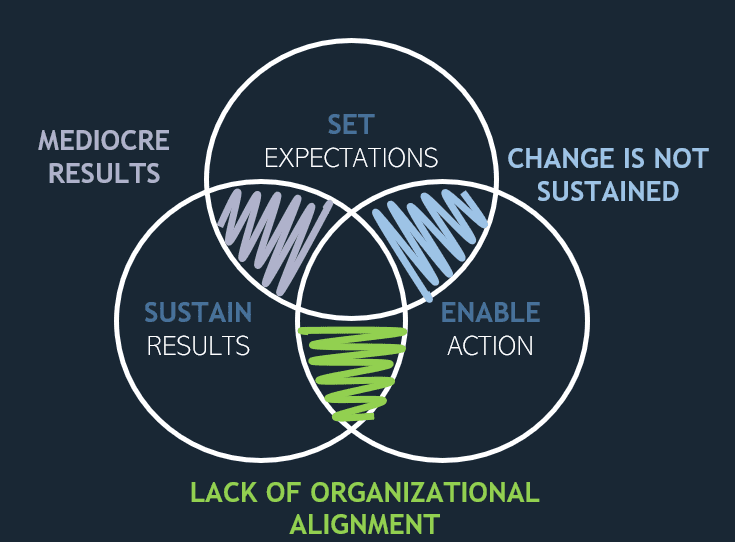
Leaders who prioritize all three create a true culture of continuous improvement, where processes drive performance, and results naturally follow.
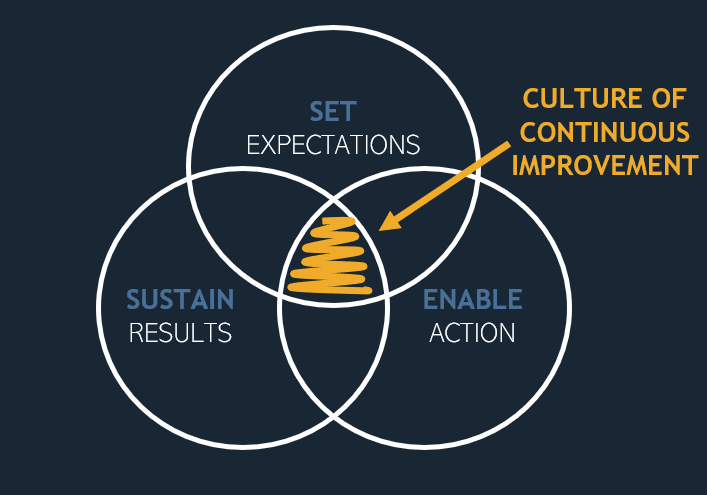
In the Marine Corps, the focus is on “preparing the mission” through rigorous planning and execution. Success on the battlefield isn’t about rushing to achieve results but ensuring every step in the process is flawless. Similarly, in Lean Thinking organizations, leaders must recognize that results are temporary if processes are neglected. It’s the investment in systems, team accountability, and daily management practices that creates sustainable success. By emphasizing process over outcomes, leaders build an environment where continuous improvement thrives, and the organization consistently delivers meaningful, long-term results.
Lesson Learned: Lean Thinking prioritizes process over outcomes. Leaders should focus on creating robust systems and addressing process inefficiencies, trusting that the results will follow. This reflects Maxwell’s emphasis on producing sustainable results by strengthening the foundation.
Final Thoughts
The transition to leadership is challenging, and it’s okay to make mistakes—as long as you learn from them. Looking back, these missteps became valuable lessons that shaped me into a better leader. For those stepping into a new role in a Lean organization, remember to:
- Ask questions before offering solutions, empowering your team to uncover root causes.
- Pace your changes to align with the team’s capacity, building confidence and momentum incrementally.
- Prioritize trust and relationships by serving your team, listening actively, and showing respect.
- Empower your team instead of micromanaging, coaching them to take ownership and make decisions.
- Focus on improving processes, not just achieving results, by setting clear expectations, enabling action, and sustaining outcomes.
Leadership isn’t about being perfect; it’s about continuously improving—just like Lean Thinking itself. By understanding and applying Maxwell’s Five Levels of Leadership, you can move from positional authority to true influence, creating a lasting impact on your team and organization. Whether in the Marine Corps, on a production floor, or at the helm of a major initiative, the principles remain the same: Lead with respect, empower your team, and focus on sustainable improvement. When you do, you not only elevate your team’s success but build a culture where continuous improvement becomes the norm.