Growing up in West Michigan provided me with a landscape that was dotted with fields, farms, and silos. Silos were a necessity for the farms in my area. They provided a simple way for the farmer to keep crops and feed dry. Separation was a must and the silo provided a basic way to achieve that goal. Often, I see companies operating using this same principle. I don’t think it’s intentional. I think it’s just the way things have always been done. Without even realizing it, we can find ourselves working in silos. Working in silos keeps us from visualizing the whole value stream and taking advantage of the expertise in our organization.
What does working in silos mean? In plain terms, working in silos means operating in a kind of bubble. Working on your own, or as part of a limited team or department that works independently from other groups. This independence is great for the farmer who wants to keep his grain isolated from the elements, but not so much for our teams. Groups and individuals may work in silos without realizing they are doing so. Although they might welcome opportunities to share data and knowledge across traditional boundaries, their organization’s structure, culture, and training might not enable this way of working. So how do we knock down the silos in our organization?
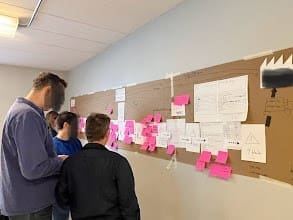
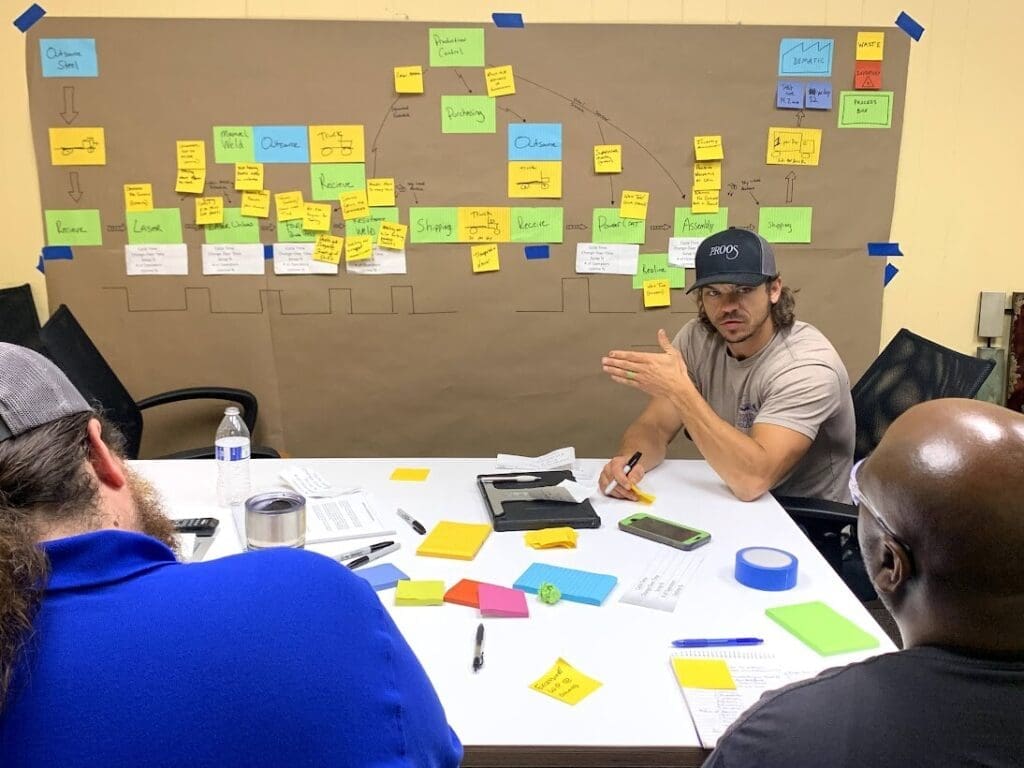
Work with your team to create a current state value stream map of the end-to-end value stream that’s in your area. Conduct an in-depth current state analysis with all departments involved. Ask questions all the way. Prepare an ideal state map showing what the value stream could look like with zero waste. Ask your team what needs to happen to get closer to the ideal state. Make sure everyone knows what the ideal state looks like.
Conduct a Value Stream Map Analysis:
Step 1: Identify customer requirements and calculate takt time
- Our customer is sometimes internal or external
- Our customer is also the shareholder
Step 2: (DATA BLOCKS) Identify Main Processes In Order
- Each one will be different and unique to the area you are working with.
- A data block is created when a person or area passes a product or service to the next step.
Step 3: Add arrows for the Flow of Information.
- Straight arrows
- Right Angles (NO diagonals)
- Information flow arrows
Step 4: Walk the Value Stream: Add inventory / delay queues. Note movement and inventory
- What will be considered the WIP? What is considered inventory?
- Inventory triangles should be noted between process blocks.
- Stay customer centric here. A customer doesn’t care if you have a price on a line item if they are waiting for a package.
Step 5: Walk the Value Stream – Populate the Data Boxes with Metrics
- Identify Key Performance Indicators for the Value Stream.
Step 6: Summarize Value Stream Metrics – Calculate Lead Time Ladder
- Lead time complete = lead time PLUS Inventory
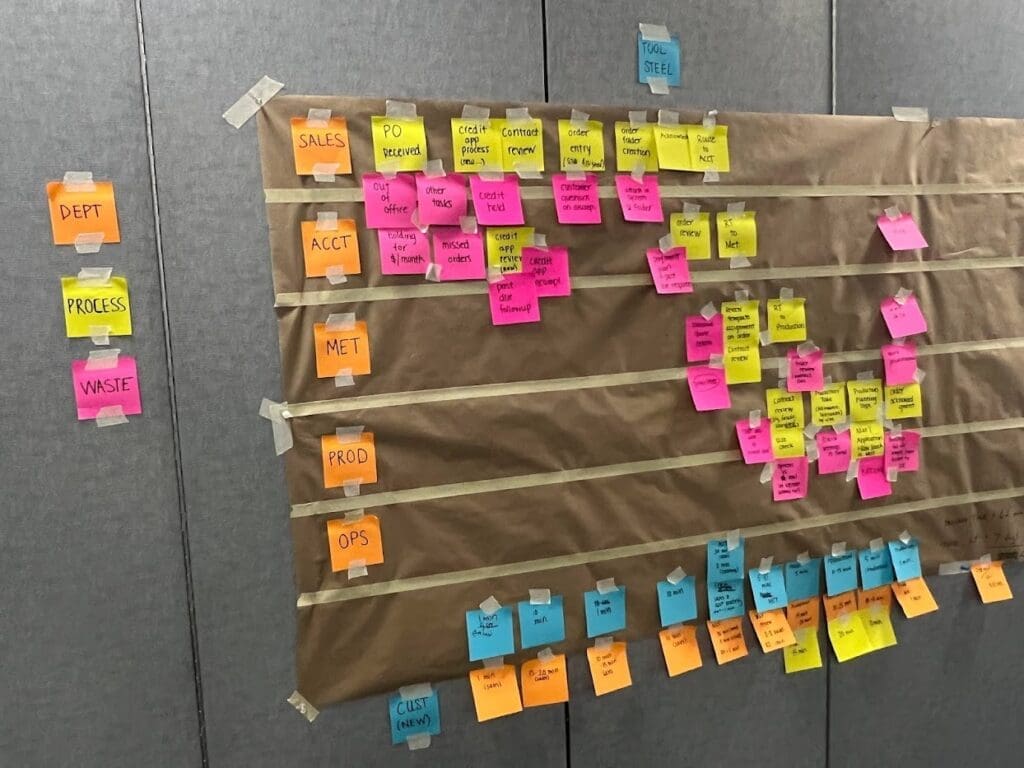
When working with administrative processes outside manufacturing, I recommend a hybrid swim-lane mapping style rather than the traditional VSM:
To master silos means to maintain a fresh perspective, to see things as they are in their current state, to ask questions and to think for yourself. It’s about having the will to trust your own perceptions instead of relying on conventional ideas because they are the way we’ve always done it. Your company has experts in the areas of your value stream. Get those experts out of their silos and watch them thrive and grow as a team. As Steve Jobs put it “Great things in business are never done by one person; they’re done by a team of people.”