“How do you change the behavior of an organization?”
You do that by changing the behavior of its leaders.
Standard work benefits the entire organization, not just front-line team members and mid-level managers. Leader standard work entails a fundamental change to ALL leader’s routines. Leaders mimic the behavior they would like to see, setting the example for best practice. As you can see the percentage of work time devoted to leader standard work varies depending on the role in the organization.
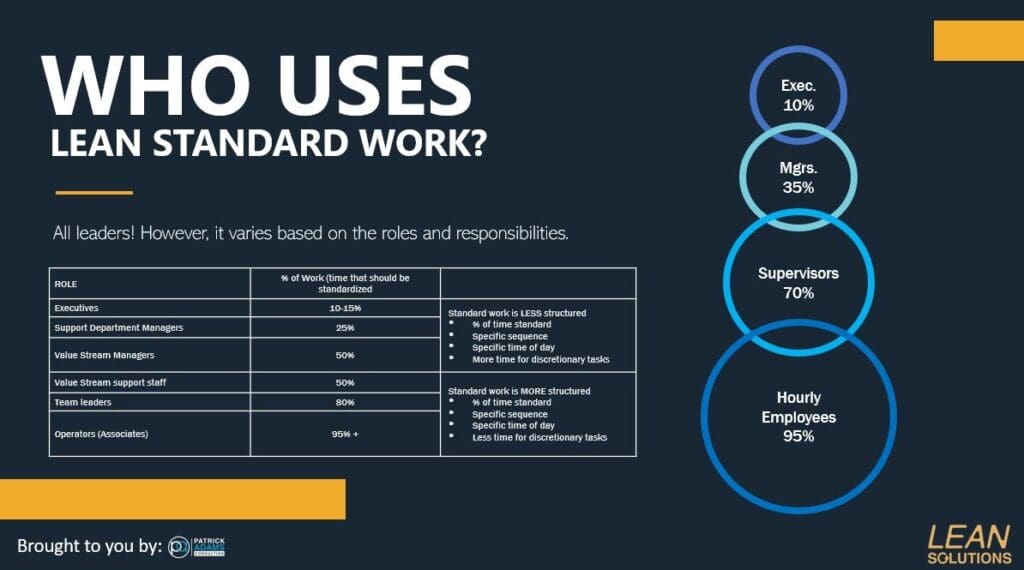
Leader standard work is a list of activities that must be done to sustain the lean management system. Because leader standard work is specific in sequence, time of day tasks are performed, and visual, it is useful for driving actions and learning. Team and mid-level leader standard work will always be more structured than executive leaders. However, that doesn’t mean executive leaders shouldn’t have some structure. In fact, every executive leader should have 10-15% of their work standardized. If executive leaders are not committed to leader standard work, then the rest of the leadership team will not perceive much value in their own leader standard work.
Demonstrating a commitment to leader standard work sets a precedent for standardization when it comes to time to develop process standards and shows that no one in your organization is above the tool. In my book, Avoiding the Continuous Appearance Trap, I mention the importance airline pilots, surgeons, and astronauts place on standard work. Do your executive leaders think their work is above open-heart surgery and rocket science?

Leaders need to standardize their own work tasks, and they also need to ensure that the teams reporting into them are working to standardized work processes. One area executive leaders can standardize their work is by being part of layered audits. Layered audits help sustain continuous improvement across an organization. Another area is gemba and/or coaching walks with their staff. These are both areas that can be scheduled on the same day and time per week and can ensure your executive leadership team is committed to their own leader standard work. When leaders verify the standard of those reporting to them, it is not about using an ‛audit’ mentality, nor is it about leaving them with a list of things to do. It is about coaching to a standard and showing through their actions that it is important to follow a standard. In this way, it becomes more of a time of structured coaching for leaders no matter the theme of gemba walk or layered audit.